The Post-it Office Supply Checklist: Laser Printers, Clip Art, and Two Calculators That Save Money
Posted on 2026-08-21 by Elena Baptista
This is the checklist I wish I had before my first office supply order. If you're setting up a classroom, training room, or small office, this is for you. I made enough mistakes in 2017 to fill a storage closet with things we never used. The checklist is basically five steps plus a mistake list. Follow it and you'll avoid the most expensive kind of error: the one that looks fine until you do the math.
Step 1: Know what your printer actually is
Before you order any Post-it products, check the machine they'll be used around. I'm not a printer engineer, so I can't help you with fuser assemblies. What I can tell you from a purchasing perspective is this: understand what a laser printer is and how it changes your supply choices.
A laser printer uses toner powder and heat instead of wet ink. It's good for text-heavy pages, and it's often cheaper per page than an inkjet when you print a lot. If someone on your team asks, what is a laser printer, the short answer is: it's the office printer that handles your everyday documents without smudging.
The reason this matters for a Post-it supply order is that your printer's capabilities affect what you can create and attach. If you plan to print labels for binder tabs or training bins, the printer's paper path matters. Also, the type of printer determines the media you can buy. I once ordered 12 rolls of Post-it Labeling Tape without checking whether our dispenser system was compatible. Turns out we needed a different dispenser. That was $240 and one very frustrated staff meeting.
Step 2: Inventory before you buy
Here's the step everyone skips: count what you already have. In 2022, I submitted an order for three cases of Post-it Super Sticky Notes. The storage closet had four more cases behind a stack of easel pads. That's a simple fix, but the surprise wasn't the duplicate order. It was how much money we had sitting unused.
A simple inventory list takes twenty minutes. You're looking for:
- Post-it Super Sticky Notes and cubes
- Post-it Durable Filing Tabs and flags
- Post-it Easel Pads
- Post-it Whiteboards and cleaning supplies
- Post-it Highlighters with Flags and dispensers
This is also where the small client thing comes up. I don't care if your office has two people or two hundred. A $200 order deserves the same attention as a $20,000 one. The vendors who treated my $200 orders seriously are the ones I still use for much larger orders.
Step 3: Use the app before you lose a good idea
One of the best additions to our workflow wasn't a product from the catalog—it was an app. If you've searched for app post it and gotten a confusing list, let me save you some time: it's called the Post-it app.
The Post-it app lets you take a picture of a whiteboard or a cluster of sticky notes, crops it, and turns it into digital text. In my first year, I photographed each board manually and filed them in folders. That was fine until I needed to find a specific note weeks later. The app fixed the finding part. Now I use it after brainstorming sessions so nothing gets lost.
(Note to self: I still say post-it for every sticky note. The brand name is Post-it, but the search term people type is still app post it. You're not alone if you do the same.)
Step 4: Create your own visuals instead of using outdated clip art
When we started labeling drawers and training bins, my first instinct was to search for post it note clip art. Honestly, the results were okay. But they looked old, and some had weird colors. So I spent 30 minutes in PowerPoint and made a basic sticky note graphic: yellow rectangle, slightly rotated, mini shadow. That became the template for all our labels.
Why bother? Because a generic clip art image doesn't match your brand or your communication style. A simple post it note clip art you make yourself is easy to update. If you don't want to make your own, the Post-it official site offers templates and images. The point is: don't let a free clip art search create an office look that screams 2004.
Step 5: Do the math twice
I am not naturally a numbers person, which is why I now use a grade average calculator and a percent decrease calculator even for simple tasks. Sounds silly? Maybe. But those two tools have saved me more money than any coupon code.
If you're a teacher, grade average calculator might sound like a school tool, not a procurement tool. But when you're tracking student performance, you need weighted grades to be correct. I once helped a friend who teaches high school set up her gradebook. We used a grade average calculator to check the weighting for participation, homework, and exams. It caught a mistake that would have changed a student's semester grade.
For budget comparisons, a percent decrease calculator is even more useful. Last year, your Post-it order was $1,250. This year, same products, $1,060. The decrease is 15.2%, not 'about 20%.' If you're comparing quotes, calculate the percent decrease accurately. I've caught three quote errors using this method.
Step 6: Build the order
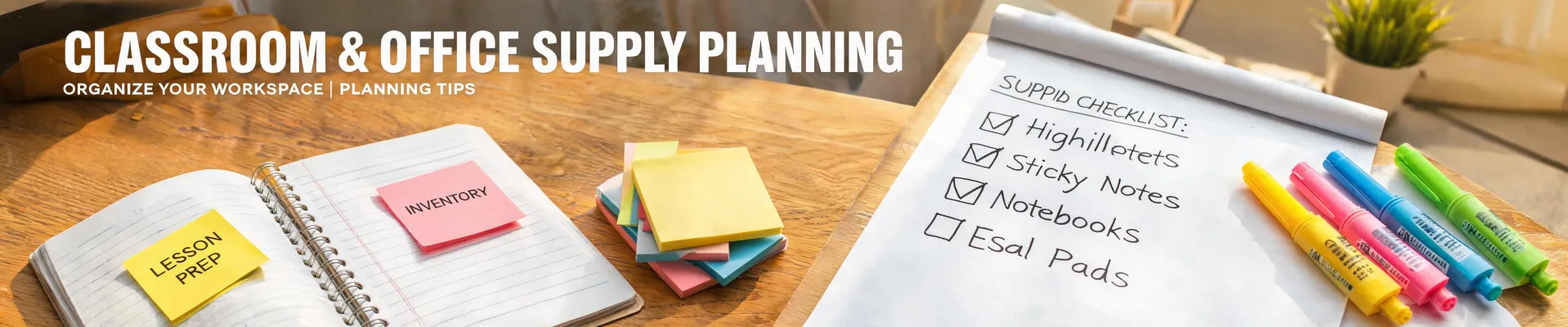
Now you're ready. Write out the product list, quantities, printer-related supplies you need, and any labels you'll print. Then check it twice.
For a typical classroom or small office setup, my go-to list looks like this:
- Post-it Super Sticky Notes (3x3 and 4x6)
- Post-it Durable Filing Tabs
- Post-it Labeling Tape and compatible dispenser
- Post-it Easel Pad
- Post-it Whiteboard
- Post-it Highlighters with Flags
If you have a vendor that treats a small order like it matters, keep that relationship. The people who took my $300 order seriously seven years ago are the ones I call when I need $12,000 of supplies.
Mistakes to avoid
It wouldn't be an honest checklist if I didn't tell you where I've slipped. Here are the big ones:
- Ignoring the closet. Inventory first. It's boring, but it stops duplicate orders.
- Printing before checking the printer. Know what a laser printer can handle before you buy label stock or expensive media.
- Relying on clip art. Make your own post it note clip art or use official templates. Generic art is a silent credibility killer.
- Skipping the math. A grade average calculator and percent decrease calculator are not only for teachers. They're for anyone who wants to catch a price mistake.
The bottom line is simple. This is a small checklist, but it's the kind of small checklist that saves real money. And if you're still wondering what is a laser printer, now you know.

Elena Baptista
Elena Baptista is an office printing and imaging analyst covering laser and inkjet printers, multifunction devices, copiers, label and receipt printers, ink cartridges, toner cartridges, and drum units. She applies ISO/IEC 24734, ISO/IEC 24711, and ISO/IEC 19798 methods while comparing print speed, first-page time, duplex throughput, duty cycle, page yield, coverage assumptions, resolution, color consistency, energy use, and maintenance intervals. Her guides help offices, schools, dealers, and procurement teams match output volume, media handling, connectivity, consumable economics, service access, and fleet-management requirements.