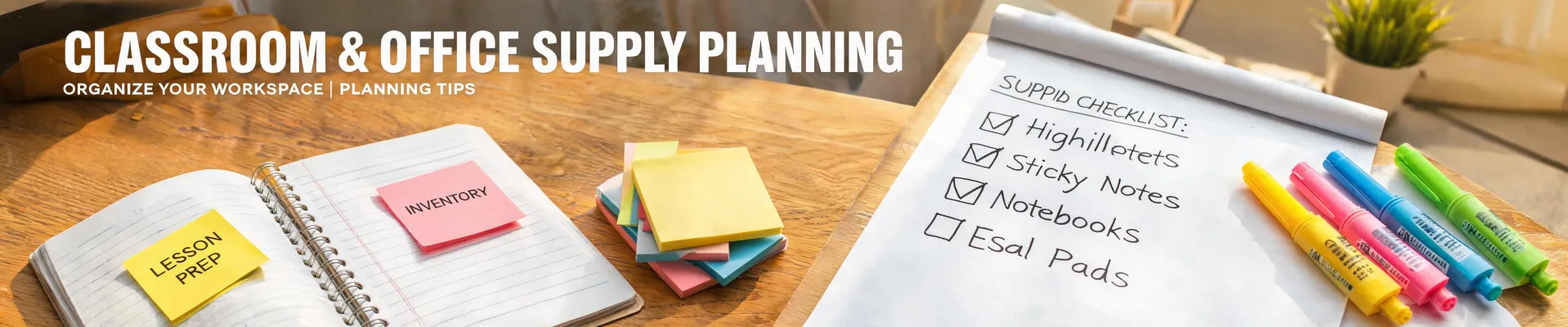
Office Buying Questions I’ve Stopped Getting Wrong: Post-it, PO Boxes, and the “Binder” Search
Posted on 2026-09-07 by Elena Baptista
Since 2019, I’ve handled purchasing and office operations for a 40-person team. In that time, I’ve made about a dozen significant buying mistakes and kept a running checklist ever since. These are the questions people actually type when they search for office help. I got most of them wrong once, so I’m writing the version I wish I’d found.
1. Is “post-it” just a fancy word for sticky notes?
Basically, yes—with one caveat. Post-it is 3M’s trademarked brand; “sticky note” is the generic term. I use both phrases daily. What actually matters is matching the adhesive to the job you’re doing.
People think sticky notes are basically the same, and the brand price is just markup. In my testing, that’s true for low-stakes notes on a desk. But when I built a wall calendar for project statuses, cheaper notes started peeling by Day 2. Post-it Super Sticky held until I took them down. At least, that’s my experience—not a lab test.
I should add that you don’t need a premium brand for every surface. For a temporary phone message, any small note works. For labels that need to stay put and release cleanly, buy the product class designed for that.
2. Is a post it easel pad worth the price?
If your goal is to keep ideas visible after the meeting ends, yes. If you just need a temporary writing surface, a whiteboard is fine. An easel pad’s real advantage is that it leaves a record. A whiteboard forgets everything; a flipchart page stays on the wall for next week’s review.
In 2021, I ordered a case of Post-it Easel Pads for an off-site planning session. We used two pads in four months, and the rest sat in storage. That wasn’t the product’s fault—it was our meeting process. When we did use them properly, the large sheets were great for brainstorming: roughly 25 by 30 inches, easy to tear off, and the self-stick version went onto painted walls without needing rolls of tape.
So my advice is simple: buy one pad first. If your team fills it and actually hangs the pages on the wall, buy more. Do not buy the case until the workflow proves it.
3. How much is it for a mailbox at the post office?
If you mean a P.O. Box at a USPS facility, it’s usually a rental, not a purchase. According to USPS (usps.com), P.O. Box rental rates depend on the individual Post Office location, the box size, and the rental period—often 3, 6, or 12 months.
My mistake was searching for a single national price. There isn’t one. I checked two Post Offices about 20 minutes apart for the same small box size, and the quotes were noticeably different. That’s why the right answer is a lookup, not a list price.
Use the official USPS P.O. Box price tool, enter the ZIP Code of the actual Post Office where you want the box, and compare sizes. If you mostly get letters, start with a small box and size up only if needed. Also, if your home or small business doesn’t have carrier delivery, ask the clerk whether you qualify for a free P.O. Box—that option exists under specific conditions. Verify it at that office before assuming.
4. Does an office need a photo printer?
Probably not. The phrase “photo printer” sounds like a must-have for office projects, but the real cost isn’t the printer itself—it’s the ink and paper that make every print expensive.
We bought a dedicated photo printer in 2022 for event signage and product shots. The hardware price looked reasonable, but the cost per print added up fast. After comparing, we shifted about 80 percent of our photo work to a local print shop and kept the photo printer only for true same-day emergencies.
What changed my thinking was seeing the per-page cost, not the machine price. If your office prints a few photos a year, use a print shop. If you print constantly, measure the ink cost before you commit. A good workflow beats a good-looking printer every time.
5. Why would an overtime calculator matter to an office manager?
Because overtime is an operations cost, not just a payroll problem. When I planned an after-hours labeling and mailing project, I budgeted for supplies but ignored the labor hours. Supplies cost around $160. The overtime cost was over four times that amount. I should have calculated the labor cost before approving the project, not after.
For U.S. teams, the federal Fair Labor Standards Act says most non-exempt employees earn at least 1.5 times their regular rate for hours worked over 40 in a workweek. State laws may be stricter. The overtime calculator does that arithmetic for you, but the insight is to use it before the work happens—not when payroll lands.
Once we started estimating overtime on the front end, we also started simplifying the work. We reduced after-hours prep by using pre-colored labels and clear steps, and the overtime cost dropped significantly. The calculator didn’t just track a cost; it made the inefficiency visible. That’s the real benefit.
6. What is a chest binder?
A chest binder is not a three-ring binder. It is a compression garment worn to flatten the chest. It’s commonly used by transmasculine and nonbinary people as part of their daily clothing and gender presentation. Chest binders are made by specialized brands, and fit matters a lot for safety and comfort.
I nearly made an awkward mistake when the word “binder” crossed my office buying notes. My first thought was office supplies. It wasn’t. This is a personal item, not a supply order, and it should not be treated like a product category in an office catalog.
If an employee is searching for information about chest binders, the helpful response is respectful and private. Don’t ask them to explain their body to you. Don’t share photos or sizes. Instead, point them to a qualified HR or benefits contact who can support them appropriately.
General reference only. Prices and regulations change—verify current U.S. Postal Service rates at usps.com and labor law details at dol.gov before quoting them internally.

Elena Baptista
Elena Baptista is an office printing and imaging analyst covering laser and inkjet printers, multifunction devices, copiers, label and receipt printers, ink cartridges, toner cartridges, and drum units. She applies ISO/IEC 24734, ISO/IEC 24711, and ISO/IEC 19798 methods while comparing print speed, first-page time, duplex throughput, duty cycle, page yield, coverage assumptions, resolution, color consistency, energy use, and maintenance intervals. Her guides help offices, schools, dealers, and procurement teams match output volume, media handling, connectivity, consumable economics, service access, and fleet-management requirements.