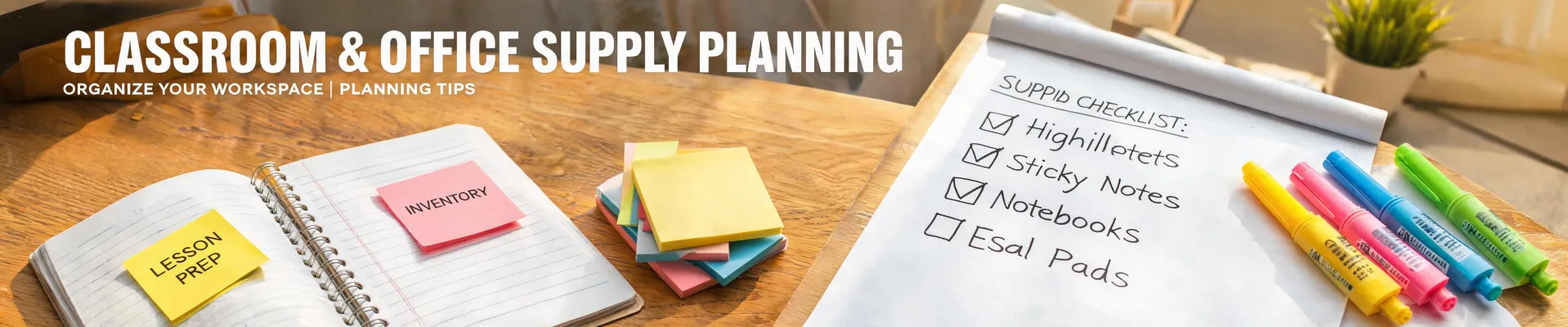
The Cheapest Office Supply Is the One That Makes You Look Cheap
Posted on 2026-09-16 by Elena Baptista
-
If You Buy Client-Facing Office Supplies by Unit Price Alone, You’re Paying for It Elsewhere
-
Argument 1: Client-Facing Collateral Is a Brand Test, Not a Commodity
-
Argument 2: Shipping Shortcuts Create Delays You Can’t Invoice Back
-
Argument 3: The “Bypass” Mindset Leaks Into Everything
-
“But We Have a Tight Budget”
-
Bottom Line: Quality Is Cheaper Than Explaining Why You Look Cheap
If You Buy Client-Facing Office Supplies by Unit Price Alone, You’re Paying for It Elsewhere
My position is simple: in B2B, the stuff your client touches is not “office supplies.” It’s your brand in physical form. I didn’t always believe that. For years, I treated Post-it notes, chart paper, labels, and mailroom packaging as line items to shave. I was wrong, and the invoice proved it.
I’m a print production coordinator handling office print, mailroom, and presentation orders for 8 years. I’ve personally made—and documented—11 significant mistakes, totaling roughly $14,200 in wasted budget. Now I maintain our team’s pre-check list. Here’s why I stopped optimizing for the lowest unit price.
Argument 1: Client-Facing Collateral Is a Brand Test, Not a Commodity
In 2017, I bought a generic case of sticky notes to save about $38. They curled. They fell off. A sales director used them to flag sections in a $3,200 proposal. During the client review, three flags dropped onto the floor. Nobody said anything. That was worse than if they had.
The lesson: when a client sees your notes, labels, or chart paper, they’re making a split-second judgment about your company’s attention to detail. We switched back to Post-it notes, and not because of brand loyalty. Post-it Super Sticky notes held on vertical surfaces. Post-it durable filing tabs didn’t peel off in transit. Post it chart paper with lines gave our training team a clean, consistent surface for workshops. The unit price was higher. The redo rate went down.
According to FTC advertising guidelines (ftc.gov), business claims need to be truthful and substantiated. That applies to your own materials, too. If your product sheets look sloppy, your “quality” claim looks unsubstantiated.
Argument 2: Shipping Shortcuts Create Delays You Can’t Invoice Back
I once said, “Just use the post office if it fits it ships.” My mailroom heard, “Use whatever packaging is closest.” Result: a flat-rate box was used for a 3.5-oz sample pack that could have gone First-Class Mail. We paid Priority Mail Flat Rate pricing for a document that didn’t need it. Worse, two other packages didn’t fit the flat-rate rules and got reworked.
According to USPS (usps.com), "If it fits, it ships" applies to Priority Mail Flat Rate packaging, not any random box. As of January 2025, First-Class Mail letter (1 oz) is $0.73; a large envelope (1 oz) is $1.50. Verify current rates before quoting clients. The real cost wasn’t the postage. It was the one-week delay while we reprinted and repackaged the samples.
That’s when I created a shipping pre-check: size, weight, deadline, and whether the client sees the packaging. If the answer to that last one is yes, the packaging is brand collateral. Don’t put a premium proposal in a beat-up box just because it technically fits.
Argument 3: The “Bypass” Mindset Leaks Into Everything
The third argument is the one people don’t like. If your team is regularly searching “how to bypass hp printer cartridge error,” you don’t have a printer problem. You have a consumables and process problem.
I know that sounds harsh. I’ve done it. In September 2022, we were behind on a 2,400-piece training packet order. A cartridge error popped up. Someone found a workaround online. We bypassed it and kept printing. The first 300 pages looked fine. By page 900, the color had shifted. We delivered inconsistent handouts to a client workshop. That error cost $890 in reprint plus a one-week delay. The client didn’t complain about the printer. They complained that we seemed “disorganized.”
Bypassing an error is sometimes necessary to finish a job. I’m not saying never do it. But if it becomes your standard operating procedure, you’re normalizing a known defect. The same logic shows up in inventory math. We started using a remainder calculator for print overage and label stock. It’s boring. It also caught 47 potential shortages in 18 months. You’d be surprised how many “rush orders” are just math you avoided earlier.
And yes, I’ll admit the odd comparison: a mulch calculator taught me the same lesson. When I re-mulched my garden, I bought bags by guesswork and ran short twice. The calculator told me coverage, not bag count. Office supplies work the same way. You don’t need 12 packs of chart paper; you need coverage for 6 workshops. You don’t need the cheapest label tape; you need labels that stay on 200 binders through a client audit.
“But We Have a Tight Budget”
Fair. I’m not saying buy premium everything. Internal draft paper can be cheap. Scratch pads for brainstorming can be cheap. Shipping boxes for internal transfers can be reused. This worked for us because we’re a mid-size B2B company with predictable print runs and client-facing deliverables. If you’re a seasonal business with unpredictable demand, the calculus might be different. If you’re shipping internationally, there are probably factors I’m not aware of.
My rule is narrower: spend on the items the client sees, touches, or depends on. Post-it notes on a final contract. Post it chart paper with lines in a paid workshop. Labeling tape on archive files a client audits. The envelope that carries the proposal. The printed page that either looks controlled or looks like you were rushing.
I can only speak to what I’ve measured. After we stopped treating these as commodity purchases, our client feedback scores on presentation materials improved. More importantly, our reprint and rush-order costs dropped enough to cover the price difference. We didn’t become a luxury operation. We became a consistent one.
Bottom Line: Quality Is Cheaper Than Explaining Why You Look Cheap
You can save $38 on sticky notes and lose a $32,000 renewal because a proposal looked sloppy. You can bypass a printer error and reprint 2,400 packets. You can guess at shipping and eat a week of delay. Or you can build a checklist, use a remainder calculator, and buy the right Post-it products for the jobs that clients actually see.
The cheapest office supply is the one that doesn’t make you look cheap. That’s not a slogan. It’s an invoice math problem I finally learned to solve.
Elena Baptista
Elena Baptista is an office printing and imaging analyst covering laser and inkjet printers, multifunction devices, copiers, label and receipt printers, ink cartridges, toner cartridges, and drum units. She applies ISO/IEC 24734, ISO/IEC 24711, and ISO/IEC 19798 methods while comparing print speed, first-page time, duplex throughput, duty cycle, page yield, coverage assumptions, resolution, color consistency, energy use, and maintenance intervals. Her guides help offices, schools, dealers, and procurement teams match output volume, media handling, connectivity, consumable economics, service access, and fleet-management requirements.