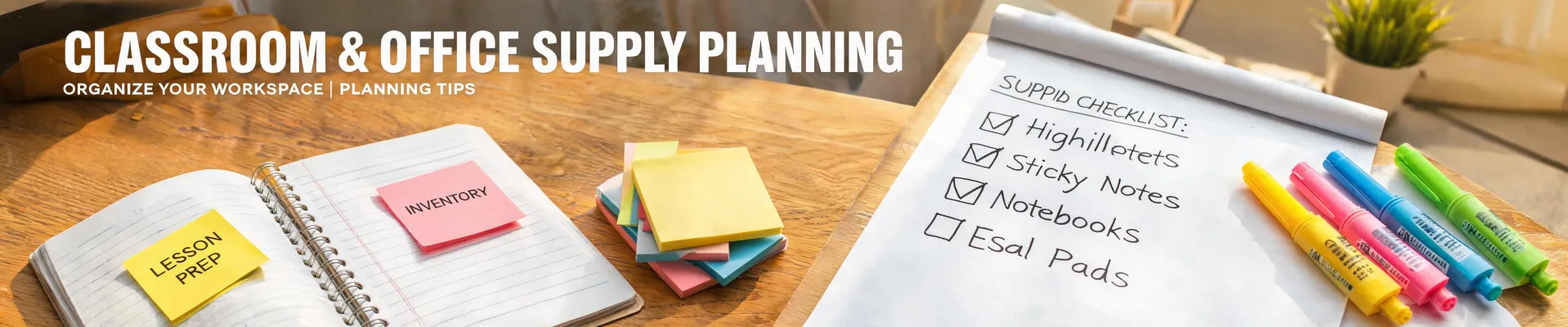
The $3,200 Office Supply Mistake: Why I Stopped Choosing Cheaper over Certainty
Posted on 2026-08-20 by Elena Baptista
In my first year handling office procurement for a mid-sized B2B company, 'cheaper' was my default answer. That default cost me roughly $3,200 in wasted budget, a lost workshop, and a near-miss on a compliance deadline. If you take one thing from this: for anything time-sensitive, pay for reliability—not just the lowest price.
I'm an admin buyer who's placed orders for Post-it products and office equipment for five years. I've personally made and documented 23 significant mistakes, totaling about $3,200. Now I maintain our team's ordering checklist to keep others from repeating my errors.
This isn't a pitch for premium brands. It's a story about how the cheapest option almost always fails when you need certainty.
The Vendor Failure That Changed My Mindset
The trigger came in March 2023. We had a client workshop scheduled and I bought an unbranded easel pad to save $30. The adhesive strip wouldn't stay on the wall, the pages tore as I flipped them, and mid-session the entire pad slipped and landed on the floor. The client's operations director gave me a look I still remember. That $30 saved created a trust gap that took months to repair.
I didn't understand the value of a reliable pad until a $3,000 contract hanging on that workshop went sideways. They warned me about cheap flip charts; I didn't listen. Afterwards, I switched to 3M Post-it Easel Pads—not because they were glamorous, but because they stuck, stayed, and didn't require a roll of tape as backup.
Here's the counterintuitive part: buying the cheap pad actually took longer. I had to prep masking tape, constantly re-press edges, and apologize when something slid. With the Post-it Easel Pad, it's one step: tear, stick, present. Certainty is a time hack.
Label Maker vs. Labels That Work
Last year, I went back and forth for two weeks between purchasing a label maker and using manual labels. The label maker seemed like a no-brainer. What I mean is the hardware was only $35, but the cartridges cost $15 each and produced maybe 200 labels before running out. During a compliance filing, it jammed three times.
We were on a deadline. I remember glancing at the clock: 90 minutes to the filing cutoff. I wanted to throw the machine out the window. We grabbed a pack of Post-it Durable Filing Tabs from the supply closet and finished by hand in 20 minutes. In my opinion, the extra cost of reliable labels is justified whenever your deadline depends on it.
To be fair, a label maker is great for high-volume, repetitive labeling. But for a small team with a deadline, the certainty of a product that works the first time outweighed the low upfront price.
How Much Is It to Open a Post Office Box? (And Why I Asked)
In our first year, we skipped renting a USPS post office box to save a few bucks. Important business mail went to an unsecured lobby mailbox. One stolen envelope containing payment notices and a contract triggered a chain of late fees, a paused vendor relationship, and a very angry finance manager.
After that, I finally asked the question many small businesses search: how much is it to open a post office box? Per USPS (usps.com), the price varies by location, box size, and rental period. As of early 2025, small boxes start around $24 for three months—verify current rates. I might be misremembering the exact numbers from our local office, but the point stands: for less than the cost of one hour of labor, we gained a secure, permanent address for business mail.
This is the certainty premium at work. You're not paying for a box; you're paying for the assurance that your documents won't vanish. The alternative left us exposed.
Toybox 3D Printer and the Rent vs Buy Calculator
About a year ago, we explored adding 3D printing for client demos. A Toybox 3D printer on sale looked tempting—low price, compact, 'just works.' We bought one. Three weeks and multiple failed prints later, I realized the real cost wasn't the machine; it was filament, maintenance, and hours of calibration for a device we'd use twice a month.
We pulled out a rent vs buy calculator and ran the numbers. Renting prototyping time from a local print service cost about 20% more per part, but it eliminated downtime, defective prints, and the 'we need a specialist to fix this' problem. The calculator made the answer obvious: for occasional use, renting buys certainty.
Put another way: the daily cost of owning can be higher than the occasional cost of renting. That tool has since saved us from several other 'cheap' equipment purchases.
Advertising Claims and What I Now Trust
FTC guidelines (ftc.gov) require advertising claims to be truthful and substantiated. In my experience, the brands that overpromise are usually the ones that underdeliver. I'm not 100% sure that label maker's marketing crossed a line, but the product didn't live up to its claim of being 'simple' and 'fast.'
Established products like Post-it don't need to scream about being the best. They just work. After my string of failures with low-end office supplies, I've shifted our budget toward tools that are boringly reliable. Not because they're flashy, but because they do what the label says—every time.
The Certainty Premium in Action
These days, when a package must reach a client by morning, I'll happily pay for overnight shipping. The $40 fee buys certainty; the alternative is a $15,000 account in jeopardy. The same logic applies to office supplies: the extra dollar for a reliable product is an insurance premium, not an expense.
When to Ignore This Advice
Let me be clear: I'm not saying always buy the most expensive option. For low-risk, daily-use items, a generic sticky note is fine. But when a client is watching, when a deadline is hard, when a mistake means redo or reputation damage—that's when you pay for certainty. The premium is small compared to the cost of failure.
Roughly speaking, the $3,200 I wasted came down to one question I never asked before ordering: 'What will this cost me if it fails?' For anything where the answer is 'a missed deadline' or 'a lost client,' the cheapest option is never the cheapest in the long run.
Prices mentioned are as of early 2025; verify current rates at official sources. Regulatory guidance is for general reference.
Elena Baptista
Elena Baptista is an office printing and imaging analyst covering laser and inkjet printers, multifunction devices, copiers, label and receipt printers, ink cartridges, toner cartridges, and drum units. She applies ISO/IEC 24734, ISO/IEC 24711, and ISO/IEC 19798 methods while comparing print speed, first-page time, duplex throughput, duty cycle, page yield, coverage assumptions, resolution, color consistency, energy use, and maintenance intervals. Her guides help offices, schools, dealers, and procurement teams match output volume, media handling, connectivity, consumable economics, service access, and fleet-management requirements.