Why 'Just Buy It' Is Draining Your Office Budget (Post-it Notes Aren't the Problem)
Posted on 2026-08-31 by Elena Baptista
Last Tuesday at 2:37 pm, someone in our building searched tip calculator google. The same week, our internal request tool got a quote for a resin 3D printer, a Slack thread about how to remove permanent marker from skin, and a purchase order for another box of Post-it notes.
These look unrelated. They’re not.
I’m a procurement manager at a 230-person logistics company. I’ve managed our office and facilities budget—about $190,000 a year—for the last seven years. I track every order in a cost spreadsheet with over 4,000 line items. The pattern is clear.
The problem isn’t the sticky notes
The surface problem is budget creep. The kind that doesn’t announce itself in one big line item. It hides in 47 small ones, each under $50, each approved for a different emergency.
When I audited our 2023 spending, $4,116 was scattered across those 47 line items. The largest was $214. The smallest was $3.29. A whiteboard marker here, a pack of label tape there, a mousepad, a bottle of hand sanitizer because somebody learned why you don’t use permanent markers on whiteboards. None of it was extravagant. All of it was avoidable.
People think small purchases create budget problems. Actually, it’s the other way around. When a budget starts to feel uncontrolled, people stop caring about the small purchases. That’s the detail that usually gets missed.
Why ‘just buy it’ is the deep cause
In my opinion, the deeper issue is ad hoc procurement culture. Every desk becomes an island. The person on that island has a problem, searches for the fastest fix, and buys without thinking about the system around it.
Offices with this culture run on three assumptions: the purchase is urgent, the amount is too small to matter, and nobody is tracking it. Usually at least one assumption is wrong.
Take the resin 3D printer request. Someone in R&D had a ‘quick idea’ and wanted to prototype overnight. The upfront quote was $289. The total cost of ownership was not. Resin, nitrile gloves, a wash station, isopropyl alcohol, ventilation, failed prints, and disposal easily pushed the one-week prototype past $2,100. I’m not 100% sure about the exact resin consumption rate, and that was part of the problem—the person asking didn’t know either.
The how to remove permanent marker from skin search is the same story, smaller. It usually means someone grabbed a permanent marker because the dry-erase marker wasn’t next to the whiteboard. What should have been a $2 product choice turned into a 20-minute cleanup and a stained hand.
Then there’s the search for post-it labels. It showed up after a filing project went sideways. Good product. Bad process. The label order was marked urgent, so we paid next-day shipping on a $7 item. According to USPS (usps.com/stamps), as of January 2025, a First-Class Mail letter costs $0.73 and a large envelope costs $1.50. That gives you a baseline for how silly an overnight label delivery is, at least from a cost perspective. That rate will probably change—the USPS adjusts prices every January and July—so don’t budget from this article alone.
The opposite example came a few weeks later. Someone asked for post-it flag highlighters. Those are the highlighters with color flags built into the barrel. They replaced three separate items we used to order: a highlighter, a pack of flags, and a ruler, because people were tired of drawing uneven lines. That request made sense. But it still didn’t have a spend category, so it still hit the budget as ‘miscellaneous supplies.’
What this chaos actually costs
I once had two hours to approve a $214 rush order for a ‘customer visit’ that turned out to be a team lunch. Normally I would have asked for an agenda. But with the regional director waiting, I said yes. In hindsight, I should have asked. The order arrived on time, the lunch happened, and the invoice taught me more than the meal did.
That’s the pattern. The cost of this chaos isn’t just the money. It’s the time spent searching, re-buying, and undoing small mistakes.
Roughly speaking, every emergency order has 20-30% built-in overhead if you count shipping, handling, and the person’s time. A $14 box of sticky notes becomes an $18 problem. A $7 label tape becomes a $22 problem when it’s express-shipped. A permanent marker mishap becomes a 25-minute disruption in a meeting.
Don’t hold me to those percentages; every company’s numbers are different. But I’ve been tracking this for seven years, and the pattern is consistent. When I added up the time, the rework, the emergency shipping, and the duplicate buying, our unplanned small spend probably cost close to $6,700 in 2024—not just the $4,116 that first showed up in the audit.
The better way: standardization over willpower
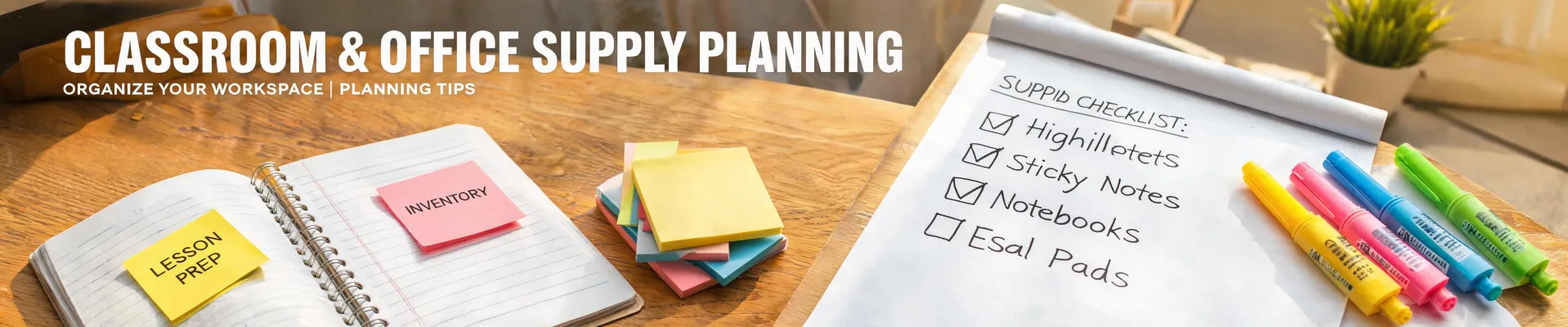
The fix, if you can call it that, is boring. Standardize the small stuff so people don’t have to think about it. Every desk gets the same basic kit: Post-it Super Sticky notes, Post-it labels, a whiteboard with the right markers, an easel pad for meetings, and a couple of Post-it flag highlighters. The kit doesn’t have to be expensive. It has to be predictable.
I’m not saying every office should go paperless. Paper still works in meetings. Use Post-it notes when paper matters, and use digital approvals when speed matters. The point is to make the right choice the easy choice.
When I first rolled out standard desk kits, I kept second-guessing. What if people thought I was micromanaging? The first two weeks were quiet. I didn’t relax until the ‘where’s the marker?’ messages dropped by maybe 40%. That number is from memory, not a dashboard, but the direction was clear.
This is not gonna sound like a revolutionary expense strategy. That’s the point. Efficiency on small things gives you capacity for bigger things. An office that stops looking for the right highlighter can spend that attention on actual work.
If your team still needs a tip calculator google to split a lunch receipt, the real question isn’t how to do the math. It’s why your reimbursement process makes people do math at all.
Standardization won’t stop every resin 3D printer request. It won’t stop someone from using a permanent marker on a whiteboard. But it cuts the number of small, expensive, avoidable decisions. To me, that’s the whole job.

Elena Baptista
Elena Baptista is an office printing and imaging analyst covering laser and inkjet printers, multifunction devices, copiers, label and receipt printers, ink cartridges, toner cartridges, and drum units. She applies ISO/IEC 24734, ISO/IEC 24711, and ISO/IEC 19798 methods while comparing print speed, first-page time, duplex throughput, duty cycle, page yield, coverage assumptions, resolution, color consistency, energy use, and maintenance intervals. Her guides help offices, schools, dealers, and procurement teams match output volume, media handling, connectivity, consumable economics, service access, and fleet-management requirements.