What 10 Years of Office Emergencies Taught Me About Post-it Products
Posted on 2026-08-19 by Elena Baptista
Here's the truth nobody in the office-supply industry tells you: Post-it notes aren't for remembering things. They're for finding things when your brain is on fire.
I'm the person who takes those calls. For the last 10 years, I've handled emergency supply requests for events, offices, and the occasional very stressed project manager. I've done over 300 rush orders—some as small as one box of flags, some as large as a full conference center setup. And the weird part? The calls are rarely about the actual product. They're about time, confusion, and a deadline that's 36 hours away. The highest-leverage move in any office crisis is having a physical system you trust—before the panic starts.
Why you should listen to me
I don't have hard data on how many office meltdowns could be prevented by a $5 pack of sticky notes. But based on a decade of watching people scramble, my sense is that more than half of them could. That's an anecdotal number, but it's an experienced one.
In my first year, I made the classic rookie mistake: I over-engineered everything. A client called because they couldn't figure out which paper tray had the letterhead. I recommended a $200 print-management software system. They never called me again. The actual fix was a labeled tray and a note on the printer. It took 30 seconds.
That lesson stuck. In a crisis, the best tool isn't the smartest one. It's the one that works in the next five minutes.
The printer problem no one solves properly
Search for "how to get my printer online" and you'll get network diagnostics, driver reinstallations, and a lot of frustration. But in my experience, the printer isn't offline. The people are offline—because they haven't made the machine's state obvious to everyone who uses it.
Here's what I tell clients: put a Post-it label on each paper tray. "Letterhead," "scrap," "ship manifest"—whatever. And a flag on the error light so the next person knows it has a paper jam before they hit print. Sounds ridiculous. But I've watched an office go from daily panic to smooth sailing with those two labels.
Most buyers focus on the expensive hardware and completely miss the low-tech stuff that actually prevents the emergency. That's the blind spot.
A math crisis, solved with office supplies
Last March, an operations manager called me at 3 PM on a Wednesday. They had a training session the next morning—40 people, handouts, everything. And the instructor had just realized she needed a quadratic formula calculator for an interactive segment. Not a print item, I know. But the real problem was that the formulas were buried in a 90-page reference manual, and there were 40 copies to mark.
We couldn't get the calculators by 8 AM, but we didn't need to. We shipped a case of Post-it flags and a couple of pop-up dispensers, and she used them to tab every formula page in every manual. The session started on time. The "technology" that saved it was paper with a weak adhesive.
That's the thing about efficiency: it's not always software. Sometimes it's 40 paper flags and a dispenser that doesn't jam.
The emergency kit I make every client build
People search for "post it office" and expect to find a single SKU that solves everything. It doesn't exist. Here's what I actually put in an office emergency kit:
- Two Post-it pop-up dispensers—one at the front desk, one in the supply closet.
- Refills. The dispenser's greatest trick is that it tells you when you're almost out. The "post it dispenser refill" is the unsung hero because it forces you to stock up before you hit zero.
- A pack of Post-it flags in two or three colors—for contracts, manuals, and "read this because it's final."
- A roll of Post-it labeling tape for shelves, trays, and cables.
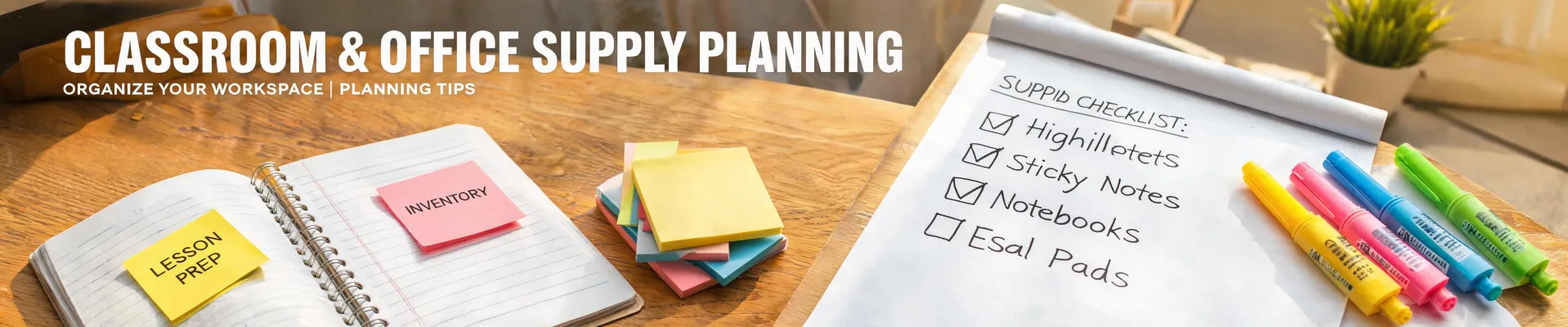
- An easel pad in the meeting room—so the action items get written where people can see them, not buried in a Slack thread.
Last fall, a client called because the board meeting was in four hours and the conference room whiteboard was covered in old notes. We couldn't send a whiteboard. But we sent an easel pad and a set of heavy-duty Post-it notes. The CEO wrote the priority list on one sheet, tore it off, stuck it on the wall. The entire meeting worked around it. That's not a product story—it's a process story. But it's the reason I include easel pads in almost every kit.
I've also seen Post-it labeling tape end a month-long war over the office fridge. That's a bit beyond office supplies, but it's the same principle: give the chaos a name, and it stops being chaos.
And honestly? I've seen the alternative. A 2-3 day rush print costs 25-50% more than standard, based on major online printer fee structures as of early 2025. I've watched people pay $80 to overnight a document they could've caught and fixed if they'd had a single flag labeling system. That's not efficiency—that's reaction.
What this doesn't fix
I have to be honest about the boundaries, because anyone who tells you sticky notes solve everything is selling something.
Post-it products aren't permanent. They won't survive a flooded basement, a chemical spill, or a label that needs to last three years. For that, you need industrial labeling—which, yes, 3M makes, but it's a different product line.
They also won't fix a genuinely dead printer port, a corrupted PDF, or a server that's down. That's an IT problem. Get a technician.
And for the record, I've had requests I couldn't fulfill. A woman once asked if we could overnight a chest binder for a shoot the next day. No idea why she called an office-supply emergency line, but we couldn't get it in time. What we could do was ship a box of binder clips and sheet protectors for the other half of her production. Some emergencies just need the right non-answer.
Final thought
So here's my actual advice: stop Googling 20-step fixes for the printer, the calculator, or the day you forgot. Go buy a few simple tools, put them where the breakdowns happen, and trust that the paper system will hold. It's not the modern answer. But it's the one that works.
Done.

Elena Baptista
Elena Baptista is an office printing and imaging analyst covering laser and inkjet printers, multifunction devices, copiers, label and receipt printers, ink cartridges, toner cartridges, and drum units. She applies ISO/IEC 24734, ISO/IEC 24711, and ISO/IEC 19798 methods while comparing print speed, first-page time, duplex throughput, duty cycle, page yield, coverage assumptions, resolution, color consistency, energy use, and maintenance intervals. Her guides help offices, schools, dealers, and procurement teams match output volume, media handling, connectivity, consumable economics, service access, and fleet-management requirements.