The Real Problem With Home Office Desks Isn’t Mess—It’s Hidden Ambiguity
Posted on 2026-08-28 by Elena Baptista
I’m a quality/brand compliance manager at a workplace products company. I review every item before it reaches customers—roughly 200+ unique products a year. In our Q1 2024 audit, we rejected 11% of first deliveries because specifications were visibly off. Seems unrelated to your home office desk? Stick with me.
Over four years of reviewing products, I’ve noticed a pattern: people buy the right tools but put them on the wrong surface. They organize papers without making decisions visible. They ask, “What’s the best desk organizer?” when they should be asking, “What do I need to see at a glance as I work?”
The Surface Problem: A Desk That Looks Organized But Doesn’t Answer Questions
Most home office desk problems look like clutter. Piles of sticky notes, scattered business cards, three half-used notebooks. Honestly, the first instinct is to buy more containers. I spent an afternoon once sorting a mess into neat labeled trays and felt very productive. By Friday, the trays were just new places where paper went to die.
Most people shop for a desk setup the same way they’d shop for furniture: they focus on size, color, and storage. They completely miss the only thing that actually matters—whether the desk tells you what to do next.
That’s because the surface problem isn’t the stuff on the desk. It’s that the desk doesn’t answer “What’s happening right now?” fast enough.
Think about the questions that actually come up mid-workday:
- “When is that report due?”
- “What did the client ask me to change?”
- “Did I send the revised version to the right person?”
- “Is it a holiday for the post office today, or can I still get this shipped overnight?”
If you can’t answer those in under five seconds, no container system is going to save you.
The Deeper Cause: You’re Storing Information, Not Making It Visible
Here’s the part most people miss. A home office desk isn’t a storage facility. It’s a decision surface. Every item on it is a signal: “I still need to do this,” “I’m waiting on this,” “Don’t lose this.” Your brain needs those signals to be visible and stable. Hide them in a drawer, and you’ve effectively removed them from working memory.
I keep thinking about a college student setup I saw last year. It was a small desk in a dorm room, and next to it was a whiteboard. On the whiteboard was a sticky note with a URL for a GPA calculator college students use to figure out what grades they still needed to protect a scholarship. That was the whole system. Simple, visible, zero login required.
That last part matters more than people think. I’ve seen teams move to digital tools that require an account, a password, and a shared drive. At some point, the work gets stuck behind a login. If you’ve ever searched for “post it login” because you needed to get back into a scanned-note app, you know what I mean. The information exists, but it’s not visible. That’s the hidden ambiguity.
The same thing happens when someone asks me how to get dry erase marker off wall. It sounds like a cleaning problem. It’s actually the opposite. The real issue is that they used a dry erase marker on a wall because there was no whiteboard surface in the room. They applied the right tool to the wrong surface. That’s basically how most home office desk systems fail.
The Cost: Small Stumbles Turn Into Real Delays
The hidden cost of this isn’t just wasted time. It’s the sense that you’re always one step behind. Let me give you a concrete example from my own work.
Earlier this year, we had a batch of 40,000 units that had to ship with a specific label. The spec was clear. The vendor approved a proof. But when the production run arrived, the label was positioned wrong. Normal tolerance is ±1/16 inch. This was off by nearly 1/4 inch. The vendor claimed it was “within industry standard.” We rejected the batch. They redid it at their cost. I want to say the redo cost us about $22,000 in delays and overtime—don’t quote me on the exact overhead—but the missed customer deadline was the real damage.
Looking back, I should have required a physical proof before production. At the time, the vendor’s previous batches had been fine. I assumed “same spec” would transfer to the actual run. It didn’t.
Your home office works the same way, just on a smaller scale. You miss a deadline because you couldn’t find the latest version of a document. You redo a task because someone didn’t see the note about a changed requirement. You spend twenty minutes hunting for a detail that should have been visible from your chair. It adds up.
Here’s what I mean by the ambiguity tax. Every time you stop to figure out what you’re supposed to be doing, you pay a small toll. If it takes ten seconds, that doesn’t sound like much. But do it twenty times a day, five days a week, and you’ve lost over an hour a week just from asking “Wait, where was I?” That’s before the missed emails and forgotten follow-ups.
This is where I’ve become a big believer in certainty as a feature. In our procurement work, we now budget for guaranteed delivery when a deadline matters. In March 2024, we paid $400 extra for rush printing because the alternative was missing a $15,000 event. The extra fee wasn’t for speed, really. It was for the certainty that the job would arrive. The same principle applies to your desk: an important note that you can see is worth more than a whole app that you can’t access.
The Short Version: Make Your Desk Answer in Two Seconds
Here’s what I’ve landed on after years of reviewing products and watching how people actually use them. The best home office desk setup isn’t the prettiest. It’s the one that answers three questions instantly:
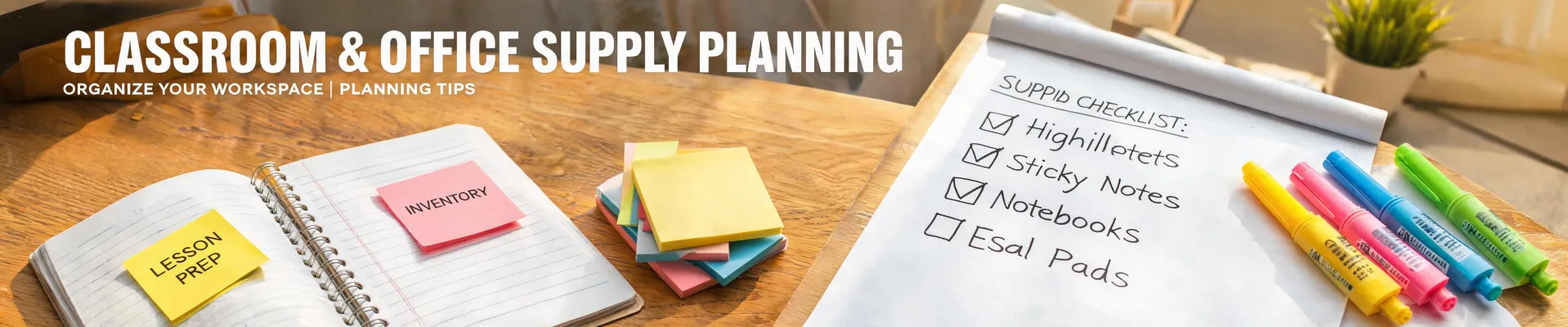
- What am I supposed to be working on right now? This is your “Today” spot. One visible note, pad, or sticky.
- What am I waiting on? This is your “Waiting” spot. Deadlines, package deliveries, pending replies.
- What must I not forget? This is your “Important” spot. Use sticky flags, labeling tape, or a small whiteboard.
If a critical package is sitting in shipping, that information should live with the task it affects. Instead of typing “is it a holiday for the post office today” for the third time, write the USPS holiday decision on the same sticky note as the deadline. The USPS publishes its holiday delivery calendar every year; check it once and move on. That’s how you turn a random fact into a useful signal.
For the college student, the GPA calculator URL was useful because it was visible at the exact moment of decision. It wasn’t buried in a folder or behind a post it login. It was just there. That’s the whole trick.
And if you’re worried about marker stains, the answer to “how to get dry erase marker off wall” is usually isopropyl alcohol or a magic eraser. But the better fix is to keep the marker next to an actual whiteboard. Match the tool to the surface.
Post-it products aren’t magic. They’re just really good at making the invisible visible. A Post-it Super Sticky note on a wall, a flag on a document, labeling tape on a tray—these aren’t decoration. They’re a low-friction way to answer the two-second questions without a login, without a power button, without a search bar.
In my line of work, quality means consistency. A compliant product works the same way every time. Your home office desk can work that way too. Not because it looks like a catalog photo, but because it consistently tells you where you are, what’s next, and what you can safely forget.
That’s the certainty worth paying for—whether it’s a rush shipping fee, a better whiteboard, or just a home office desk that stops losing information.

Elena Baptista
Elena Baptista is an office printing and imaging analyst covering laser and inkjet printers, multifunction devices, copiers, label and receipt printers, ink cartridges, toner cartridges, and drum units. She applies ISO/IEC 24734, ISO/IEC 24711, and ISO/IEC 19798 methods while comparing print speed, first-page time, duplex throughput, duty cycle, page yield, coverage assumptions, resolution, color consistency, energy use, and maintenance intervals. Her guides help offices, schools, dealers, and procurement teams match output volume, media handling, connectivity, consumable economics, service access, and fleet-management requirements.