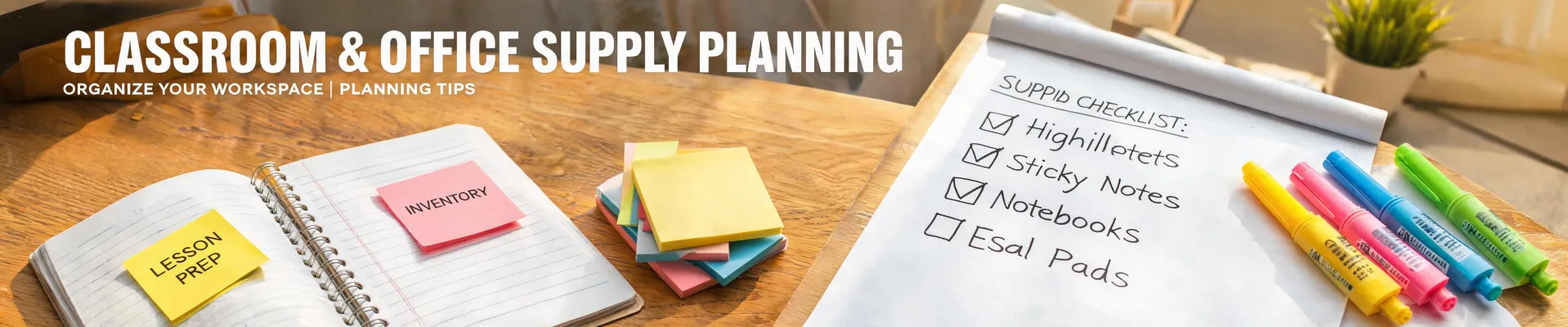
The Post-it Note Desk Organizer Debate: An Office Buyer’s Contrarian Take
Posted on 2026-08-05 by Elena Baptista
Here’s my controversial take: Most office supply problems are not supply problems. They’re systems problems. The answer isn’t always to buy more. It’s to buy with a clearer picture of how the product will be used.
I’m the office administrator for a 240-person company. I manage about $180,000 in annual spending across seven vendors, and I report to both operations and finance. I’m not saying this to impress you. I’m saying it because I don’t buy Post-it notes out of nostalgia. I buy them because they have to hold up for real deadlines and real client calls.
So let me be blunt: Post-it notes are not a commodity to me. They’re a visual operating system.
Sticky Notes Are Workflow, Not Stationery
Most people don’t realize that a sticky note in a box has no value. It’s potential value. It only becomes useful when someone sees it at the exact moment they need to act. A post it note desk organizer doesn’t need to be fancy. It just needs to put the next reminder in your line of sight. If a reminder is hidden in a drawer, it stops existing.
I learned this the hard way. In 2021, our marketing team had four boxes of sticky notes in a communal cabinet. Every week someone asked me to order more. When I cleaned out the cabinet, I found over 350 unused notes sitting in boxes. The problem wasn’t the supply. It was the placement.
I changed the system. Each person who asked for notes got a small organizer on their desk, and I started using 3M Post-it Super Sticky Notes instead of basic ones. The difference wasn’t magic—it was visibility. Notes stopped landing in drawers, and the ones that went up stayed up.
Why I Order the 3M Post-it Super Sticky Notes Miami Collection
I know, “Miami Collection” sounds like marketing. I’m usually skeptical of product collections. But the 3M Post-it Super Sticky Notes Miami Collection is genuinely useful for one reason: color, used carefully.
I use yellow for action, pink for waiting, orange for blocked. The Miami Collection has enough contrast that these categories don’t blur together. A yellow note and a peach note that look almost the same are useless for status tracking. With this collection, I can glance at a whiteboard and see where momentum is stuck.
There’s also a practical question of adhesion. I stick task cards to a glass wall in our conference room. Super Sticky notes stay there for a week. Regular notes start curling by day one. I don’t think every office needs a fancy collection. I think every office needs an intentional system. If the colors mean something and stay where you put them, the system works.
The Office Questions I Actually Get
Here’s the thing: a good office buyer doesn’t just place purchase orders. They answer the weird questions that don’t fit on a requisition form. These three come up all the time.
How long will mail take from zip code to zip code?
People search for a “how long will mail take from zip code to zip code calculator” all the time. I wish USPS had one simple tool, but it doesn’t publish a universal zip-to-zip calculator for ordinary First-Class Mail. A letter from New York to New Jersey moves differently than a letter from Maine to Oregon. What USPS does publish is a service standard: First-Class Mail is expected in 1–5 business days. As of January 2025, a First-Class Mail letter (1 oz) costs $0.73. If you need a firm date, use a tracked class or a mailing service. The post office’s “estimated delivery” tools work better for packages than for a single letter dropped in the blue box.
Should we buy an Epson EcoTank printer?
Maybe. Epson EcoTank printers usually cost more upfront because they use refillable ink tanks instead of cartridges. The operating cost gets lower if you print enough volume. We put an Epson EcoTank printer in our shared design room in 2023. We stopped replacing cartridges every month, and the refill bottles lasted months. That was a no-brainer for us. But if your office prints 50 pages a month, a cartridge printer is fine. Match the machine to the actual page count, not to a Reddit recommendation.
So, how to choose an office chair?
Start with adjustability, not style. I check four things: seat height range, lumbar support, armrest positions, and whether the base has five points for stability. A chair that looks great but has no lower-back support is a deal-breaker. A chair that’s too low for the desk is a pain in the neck—literally. Try to find one where the seat pan depth doesn’t push your knees forward. That, and not the brand label, is what makes a chair worth buying.
What do sticky notes, mail, printers, and chairs have in common? They all depend on context. The right office purchase is the one that fits the way your team actually works. That’s why I don’t make a vendor decision without asking who will use it, where it will live, and what happens when it breaks.
What Office Buyers Get Wrong
Here’s something vendors won’t tell you: the first price is rarely the final price for an ongoing relationship. Once you’ve shown you’re a reliable customer, there’s usually room to negotiate on volume, delivery, or support. I’ve used that on printer supplies, chairs, and even our standing order for Post-it products.
And here’s a mistake I made early on: I assumed a clear desk meant a clear mind. In reality, an empty desk without a visible system just hides the problem. A Post-it note desk organizer is not clutter. It’s a territorial map for your attention. The best system is the one you don’t have to think about.
Looking back, I should have standardized our note system before our 2022 office move. At the time, I didn’t want to look controlling. But after three people missed the same deadline because each had a different “system,” I realized that inconsistency was the real cost. The notes themselves were almost free. The energy spent trying to recall where things were wasn’t.
One objection I hear often: “You’re just saying that because Post-it is the familiar name.” Fair enough. I’m not saying Post-it is the only product that works. I’m saying a product that stays visible and stays sticky is worth more than a product that forces your team to rebuild the system every week. If you find another option that does that, use it.
So here’s my bottom line: Buy office supplies like infrastructure, not decoration. A visible sticky note, a reliable printer, a chair that supports a human body, and a realistic USPS mail estimate are all part of the same goal: reducing friction.
I’d rather spend ten minutes explaining why one option works than deal with another week of mismatched expectations. An informed customer asks better questions, and a buyer who asks better questions saves more money than one who simply buys the cheapest SKU.
The most expensive office supply is one that fails when someone is counting on it. If a post it note falls off the wall, if a printer jams twice a day, if a chair makes someone’s back ache, you haven’t saved money. You’ve added friction.
That’s why I’m picky about Post-it. Not because I’m a brand cheerleader. Because when the system works, the small stuff stops stealing attention. And in a 240-person company, the small stuff is where time disappears.

Elena Baptista
Elena Baptista is an office printing and imaging analyst covering laser and inkjet printers, multifunction devices, copiers, label and receipt printers, ink cartridges, toner cartridges, and drum units. She applies ISO/IEC 24734, ISO/IEC 24711, and ISO/IEC 19798 methods while comparing print speed, first-page time, duplex throughput, duty cycle, page yield, coverage assumptions, resolution, color consistency, energy use, and maintenance intervals. Her guides help offices, schools, dealers, and procurement teams match output volume, media handling, connectivity, consumable economics, service access, and fleet-management requirements.