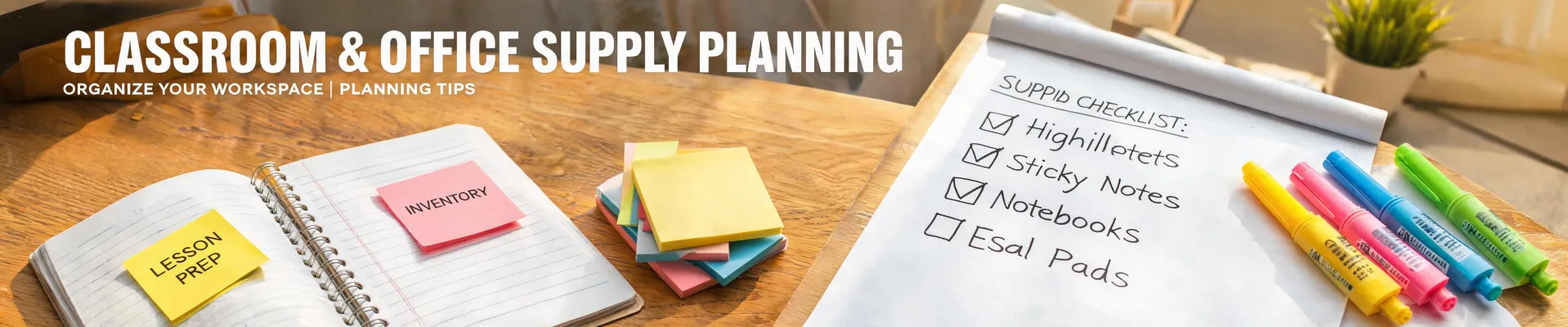
Small Office, Small Budget, Small Tools — That's Your First Mistake
Posted on 2026-08-25 by Elena Baptista
-
Mistake #1: I bought planning tools that couldn't stick around
-
Mistake #2: I treated digital files like an afterthought
-
Mistake #3: I blamed the printer when the setup was the problem
-
The "We'll Upgrade Later" Myth Is Costing You More Than Sticky Notes
-
Final Word: Small Tools Are the Enemy of Small Offices
I've spent the last eight years on the ordering side of office supplies, mostly for small teams, non-profits, and solo founders. In that time I've personally made—and documented—fifteen avoidable mistakes that totaled roughly $3,200 in wasted budget. Not a fortune, but real money when your "office" is you, a laptop, and two contractors.
So here's the opinion I've landed on: a small office shouldn't buy "small" tools. It should buy the same tools a big company would use—just fewer of them. Buying the cheapest sticky notes, the free clip art, the printer that's "good enough" seems smart when money is tight. In practice, it's backwards. The smaller you are, the less slack you have, so every tool has to work the first time.
Mistake #1: I bought planning tools that couldn't stick around
In September 2019, I ordered chart paper and sticky notes for a client's offsite planning day. I went generic to save about twenty dollars. We covered a wall with a roadmap and action items. By lunch, half the notes had peeled off, and the chart paper kept curling. The client spent the afternoon re-explaining things instead of deciding things. The session lost an hour and a half. That's when I learned the difference between a piece of paper with glue and a planning tool that earns its place on the wall.
We switched to Post-it brand post it note chart paper—the kind with the sticky strip—and Super Sticky notes. They held through humidity, through a full week on a whiteboard, through people grabbing them by the corner. Yeah, they cost more per sheet. But a failed planning session costs three hours and the confidence of everyone in the room. I'd rather reorder supplies than reschedule a meeting.
Mistake #2: I treated digital files like an afterthought
In spring 2021, we needed a banner for a small trade show booth. The client wanted a playful "sticky note" visual, so the designer searched for post it note clip art and pulled something that looked crisp on a laptop screen. Printed at two feet wide, it was a pixelated mess. The print shop caught it, we paid for a rush reprint, and the project cost us an extra $580.
Now I check resolution before approving anything. Commercial print standard is 300 DPI at final size. If an image will be 24 inches wide, you need at least 7200 pixels across (24 × 300). And color is its own trap: Pantone gives brand-critical colors a Delta E tolerance, and anything under 2 is considered a solid match. If you're not checking numbers like those, you're gambling with the print budget. I don't have hard data on how many small-business print jobs come back wrong, but based on what I've seen, most of them were preventable.
The clip art wasn't the villain, by the way. The real villain was assuming "it looks good on screen" means something once it's printed. It doesn't.
Mistake #3: I blamed the printer when the setup was the problem
In February 2023, a client called, genuinely frustrated: "Why is my HP printer printing blank pages?" They'd already replaced the ink cartridge and were one click away from buying a new printer. I asked them to check the print queue. It was stuck on an old job. We cleared the queue, reinstalled the driver, and the printer worked perfectly. The hardware was fine the whole time.
Blank pages from an HP printer are usually one of these things: a corrupted driver, a stuck print queue, a partially clogged printhead, or a cartridge that wasn't seated properly. Only after you've ruled all of those out should you start thinking about replacement. Diagnose before you replace. That rule applies to more than printers.
The "We'll Upgrade Later" Myth Is Costing You More Than Sticky Notes
I hear this from smaller customers all the time: "We'll get the good stuff once we're bigger." I used to say it myself. It's wrong for a simple reason: bad tools slow down the growth that was supposed to fund better tools.
It also assumes cheap alternatives are "good enough." Take sticky notes: it's tempting to think all paper with adhesive is the same. But the adhesive formula, the paper weight, and the removability are exactly where cheap versions fail. They curl, they tear, they fall off. If the note falls off the wall, the idea falls off the agenda.
Here's a comparison I sometimes use with clients. You wouldn't put a $200 Pokemon card collection in a flimsy folder. You'd buy a proper pokemon binder with nine-pocket sleeves and a sturdy spine, because the cards matter to you. But the same people will use falling-apart sticky notes for their business plan, because "it's just paper." Your projects deserve the same care as a card collection.
Think about the planning mindset students use: a college gpa calculator doesn't just tell you your average—it tells you what grades you need next semester to hit your target. That's the whole difference between reacting and planning. Small offices should run the same calculation on every purchase: if this tool fails, what does the hour cost?
Final Word: Small Tools Are the Enemy of Small Offices
Looking back, almost none of my $3,200 in mistakes came from spending too much. They came from spending on the wrong thing, or not spending when it mattered. The fix wasn't a bigger budget. It was a checklist: resolution before print, diagnostics before replacement, and planning tools that actually hold up.
A small order isn't a small deal. The vendors who treated my $200 orders seriously are the ones I still use for $20,000 orders. And the same logic applies to the tools themselves. You don't need a big office to justify a good one.
So, small team? Buy the post it supplies that stick, use post it note chart paper for your next planning session, skip the low-res post it note clip art, run your numbers through a college gpa calculator, keep your rare cards in a decent pokemon binder, and if your HP printer prints blank pages, check the driver before you panic.
A small office has no room for bad tools. Buy the ones that do their job—no matter what your budget says.
Elena Baptista
Elena Baptista is an office printing and imaging analyst covering laser and inkjet printers, multifunction devices, copiers, label and receipt printers, ink cartridges, toner cartridges, and drum units. She applies ISO/IEC 24734, ISO/IEC 24711, and ISO/IEC 19798 methods while comparing print speed, first-page time, duplex throughput, duty cycle, page yield, coverage assumptions, resolution, color consistency, energy use, and maintenance intervals. Her guides help offices, schools, dealers, and procurement teams match output volume, media handling, connectivity, consumable economics, service access, and fleet-management requirements.