I Wasted $3,200 on Office Organization. Here's What Works by Scenario
Posted on 2026-08-14 by Elena Baptista
-
There's No Perfect Office Organization System
-
Scenario 1: Collaboration-Heavy Teams Need Visual, Temporary Systems
-
Scenario 2: Shipping Operations Need Labeling Discipline and Box-Size Accuracy
-
Scenario 3: Schools and Events Need Branded, Communicative Materials
-
How to Figure Out Which Scenario You're Actually In
There's No Perfect Office Organization System
I've been handling office supply and operations orders for eight years. I've personally made — and documented — 14 significant mistakes, totaling roughly $3,200 in wasted budget. Now I maintain my team's office organization checklist so other people don't have to repeat my errors. A lesson learned the hard way.
Here's the thing: office organization isn't a product you buy. It's a process that has to match how your team actually works. What works for a design studio doesn't work for a shipping warehouse. What works for a classroom doesn't work for a sales floor.
After years of trial and error, I've found that most offices fall into one of three scenarios:
- Collaboration-heavy teams that need visual, temporary tools
- Shipping and mail-order operations that need labeling discipline and box-size accuracy
- Schools, events, and creative spaces that need branded, communicative materials
I've made expensive mistakes in all three. Here's what I'd do differently — and what you should consider before you buy anything.
Scenario 1: Collaboration-Heavy Teams Need Visual, Temporary Systems
If your team spends at least a couple of hours per day in meetings, brainstorming, or whiteboard sessions, your organization system needs to be visual and temporary. Permanent documentation tools will fight you.
In March 2017, I submitted an order for a complete archival filing system for a team of 12 — premium binders, hanging folders, color-coded tabs. It looked fine in the catalog. The result came back as 40 binders sitting unopened on a shelf. $890, straight to storage. I only believed that visual tools matter after ignoring the advice for a year and eating the cost.
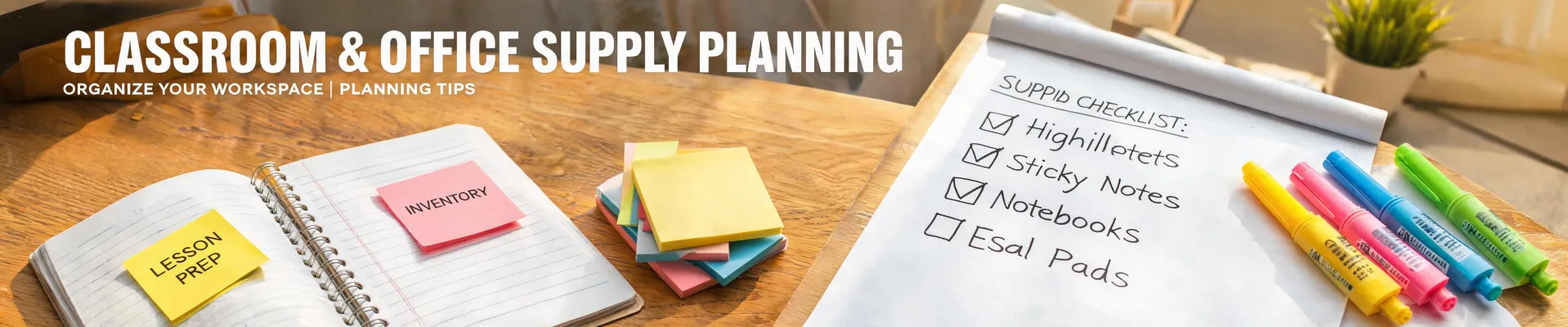
What finally worked: Post-it Super Sticky Notes as the team's idea-capture system. They hold up on whiteboards and painted drywall, they're removable, and they let people move ideas around before committing. We also started using Post-it Easel Pads for planning sessions. No one had to transcribe anything. Sheets went to the wall, stayed there for a week, and got archived only if someone actually referenced them.
Everything I'd read about office organization said you need documented workflows to be professional. In practice, for our team, the sticky-note system outperformed the expensive binders every single time. The lesson: in a collaborative environment, make thinking visible — not just documented.
Scenario 2: Shipping Operations Need Labeling Discipline and Box-Size Accuracy
This one took me the longest to get right. For years, our shipping station was a source of recurring surprises — and not the good kind.
I once ordered 12 boxes in the wrong size for a client's fragile manuals. Checked the order myself, approved it, processed it. We caught the error when the first box came back crushed, label half-peeled, contents damaged. $450 wasted, credibility damaged. Lesson learned: always verify dimensions before purchasing.
The fix came in two parts. First, know your box sizes. The post office's flat-rate program works on a simple promise: if it fits, it ships. But there are multiple box sizes, and choosing wrong costs you twice. We created a laminated dimension chart and hung it next to the scale.
We also added a percent error calculator to our operations spreadsheet to track which size estimates were consistently off. If you're not familiar with it, percent error is simply |measured − accepted| ÷ |accepted| × 100. It sounds like high-school math, but it's a genuinely practical way to see which estimates keep failing.
Second, labeling is non-negotiable. We switched to Post-it Label Tape for outgoing cartons and Post-it Durable Filing Tabs for internal tracking. The label tape is removable — which sounds like a drawback, but it's exactly what you want when an address needs correcting. It holds well enough for cartons. The tabs let our dock team flag issues before packages leave: missing contents, wrong addresses, fragile items. The surprise wasn't the products. It was how much faster our dock moved when anyone could spot a problem in two seconds instead of opening every box to inspect it.
To be fair, this system isn't flashy. But the numbers back it up. In Q3 2024, we caught 47 potential shipping errors before they turned into returns (Source: our internal ops log). Granted, that's one team's experience — but it changed how I think about shipping checklists.
Scenario 3: Schools and Events Need Branded, Communicative Materials
If you're organizing a classroom, a teacher prep room, or a conference, the rules change completely. Your organization system doubles as a communication tool. It's not just about finding things — it's about showing things to people.
In 2022, I ordered generic plain-labeled office supplies for a school district. They sat untouched in the supply closet. Then I ordered custom school bus post it notes for the same client — small, school-bus-shaped sticky notes with district branding. Teachers used them constantly: lesson plans, library books, hallway doors. The generic ones stayed in the drawer. The custom ones became part of the school's visual language.
This applies to events too. Plain lanyards are disposable. Branded lanyards become keepsakes. I've seen conference attendees wearing them months later — that's organization that respects the user and doubles as low-cost marketing.
But here's the contrarian take: DIY is not always cheaper. I once decided we'd save money by painting our own signs and labels with acrylic paint. How hard could it be? The first attempt looked acceptable from five feet away. Up close, the edges were uneven, the stencil bled, and the paint chipped off plastic surfaces within a week. $180 in materials, then $260 in reprints. $440 total, versus roughly $150 for printed custom notes.
That said, acrylic paint has its place. For canvas wall art or team murals, it's excellent — use thin layers to prevent chipping, prime plastic surfaces first, and seal with a clear coat if the piece will be handled. Just don't use it for functional labels.
When we do order printed materials, online printers like 48 Hour Print work well for standard runs like custom sticky notes and signage — quantities of 25 or more, standard turnaround, reliable delivery. The value isn't just the speed. It's the certainty of knowing your deadline will be met.
How to Figure Out Which Scenario You're Actually In
Not sure which situation fits your office? Here's the litmus test I use:
1. Do your people write on surfaces at least once a week? Whiteboards, flip charts, sticky notes, window markers. If yes, you're in Scenario 1. Prioritize visual, temporary tools: Post-it Super Sticky Notes, easel pads, a decent whiteboard. Don't spend on binders until the wall system is in place.
2. Does your office ship or receive physical items more than ten times a week? If yes, you're in Scenario 2. Prioritize labeling consistency and box-size accuracy. A laminated chart, a label dispenser, and a verification checklist will save you more than any fancy organizer. Build the percent error check habit for your size estimates.
3. Do you host events, run classes, or train people who don't work for you? If yes, you're in Scenario 3. Prioritize branded, communicative materials: custom post-it notes, lanyards, flags, and printed signage. And don't let a DIY impulse eat your budget. Unless you're already skilled with acrylic paint, order printed.
Most offices I've worked with are a blend of all three. That's fine. Start with whichever scenario is causing the most friction today. If someone can't find the dry-erase markers, fix that first. If packages have bounced back twice this month, fix the shipping bench first. If your event attendees look identical and confused, invest in better materials.
One more thing: prices and box sizes change. USPS flat-rate box dimensions are current as of April 2025, but verify at usps.com before building a plan around them. Product pricing varies by vendor and order size. These recommendations are a starting point — not a quote, and definitely not a guarantee.

Elena Baptista
Elena Baptista is an office printing and imaging analyst covering laser and inkjet printers, multifunction devices, copiers, label and receipt printers, ink cartridges, toner cartridges, and drum units. She applies ISO/IEC 24734, ISO/IEC 24711, and ISO/IEC 19798 methods while comparing print speed, first-page time, duplex throughput, duty cycle, page yield, coverage assumptions, resolution, color consistency, energy use, and maintenance intervals. Her guides help offices, schools, dealers, and procurement teams match output volume, media handling, connectivity, consumable economics, service access, and fleet-management requirements.