Why I Swear by Prevention: What 200+ Rush Orders Taught Me About Office Emergencies
Posted on 2026-07-08 by Jane Smith
Preparation beats panic every time
After coordinating more than 200 rush orders in the last four years—including same-day turnarounds for Fortune 500 clients—I've learned one thing that most people get wrong: the best way to handle an emergency is to never let it become one. Sounds obvious, right? But in practice, I see the same preventable mistakes over and over.
In my role triaging last-minute requests for corporate events, I've watched teams scramble because they skipped a 5-minute checklist. I've seen a $50,000 contract slip away because someone didn't check the ink levels on the HP printer before the final print run. I've watched perfectly good projects implode because nobody used a simple period calculator to figure out the actual timeline.
Let's break down the three places where prevention saves the most time, money, and sanity.
1. The 2-minute flag that saves 2 days
Most buyers focus on the big deliverables—the presentation, the signage, the handouts. They completely miss the small organizational details that make or break a project. The question everyone asks is 'what's the deadline?' The question they should ask is 'how do we keep track of what's done and what's not?'
Here's a specific example from November 2024: A client called at 4 PM on a Thursday needing 500 customized folders for a Friday morning sales kickoff. Normal turnaround for that vendor was 5 business days. We found a shop willing to do it overnight—for $1,200 in rush fees on top of the $800 base cost. The job got done, but the real problem wasn't the timeline. It was the 23 minor changes that came in piecemeal over the evening. Each one added a call, a confirmation, and a risk of error.
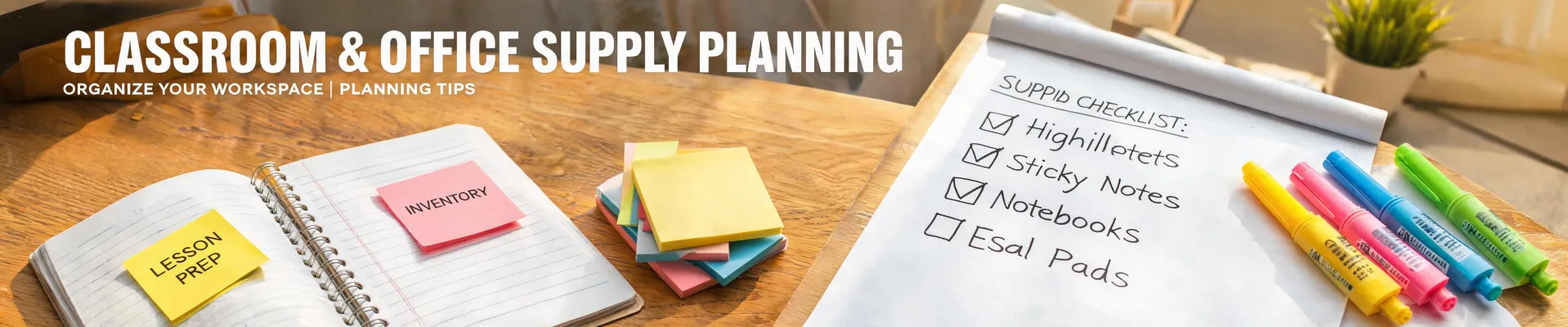
Now I use Post-it tape flags for every multi-step project. Different colors mark different statuses: yellow for 'needs review,' pink for 'changes pending,' green for 'approved.' It's stupidly simple. But that system has caught three critical errors in the past year—including a misaligned logo on a banner that would have cost $600 to reprint. Five minutes of flagging beats five days of redo.
I also keep a pack of Post-it Super Sticky notes on every desk in our prep area. When a last-minute change comes in, we write it down, stick it on the project folder, and date it. No more 'I thought you said…' conversations. Granted, it feels old-school. But it works. Period.
2. The printer check everyone forgets
Here's a truth that hurts: most office emergencies aren't dramatic supply chain failures. They're stupid stuff like running out of toner at 6 PM before a board meeting. I know because I've been there. Twice.
During our busiest quarter in 2023, three clients needed emergency printing simultaneously. The first thing I learned was how to check ink levels on an HP printer—fast. Most people don't realize you can do it from the printer's control panel (Setup → Supplies → Estimated levels) or via the HP Smart app. Takes about 15 seconds.
I now have a rule: before any print run over 50 sheets, check the levels. In March 2024, that saved a $12,000 project. We were about to start a 300-page proposal when I noticed the black toner was at 12%. Twenty minutes later we'd swapped cartridges. If we'd waited until the middle of the run… well, the client would have missed their submission deadline.
To be fair, checking toner every single day is overkill. But knowing how to do it, and having a spare cartridge in the cabinet, is basic prevention. That's why I keep a Post-it label on the cabinet door that says 'toner stock' with the date of last check. Simple. Effective.
3. The math most people skip
I have mixed feelings about calculator apps. On one hand, they're everywhere. On the other, most people grab the wrong formula. In my experience, two calculators prevent most project disasters:
- A period calculator – not for biology, but for timeline math. When a client says 'we need it by the 15th,' I don't trust my mental arithmetic. I plug in the start date, the number of business days, and check for holidays. One time in October 2023, the client said 'two weeks.' A period calculator showed that included Thanksgiving week. We adjusted. That alone saved a $1,500 rush fee.
- A dividend calculator – I use this to justify investments. When my boss questioned the $400 expense for a spare toner set and a box of Post-it products, I ran the numbers: $400 upfront versus an average of $2,000 per rush print job (three of which we'd had the previous quarter). At a 400% dividend, the decision was obvious. The calculation was: $2,000 × 3 = $6,000 wasted on rush fees; $6,000 ÷ $400 = 15× return. That's a dividend any investor would love.
But here's the outsider blindspot: most people think calculators are for finance or science. They never consider using them for project logistics. The question everyone asks is 'what's the budget?' The question they should ask is 'what's the actual cost of rushing?'
What about the naysayers?
I get it. Some people say 'my team is too busy for checklists' or 'we've never had a toner emergency, so why bother?' I used to think that way too.
In my first year on the job, I made the classic rookie mistake: I trusted verbal confirmations. A salesperson said the print vendor could handle 'rush.' I didn't check the specific lead time. Cost us $800 in extra shipping and a very angry client.
Another time, I skipped the final review because we were behind schedule and 'it's basically the same as last time.' It wasn't. The client's name on the cover page was misspelled. $400 reprint.
I knew I should have used a checklist. But I thought 'what are the odds?' Well, the odds caught up with me. Twice. That's when I implemented our '15-minute prep rule': before any critical project, spend 15 minutes on flags, printer check, and calculator math. It's not much. But it's everything.
Prevention is the only shortcut
There's something satisfying about a perfectly executed emergency order. After all the stress and coordination, seeing it delivered on time and correct—that's the payoff. But the real satisfaction comes from knowing you didn't have to scramble in the first place.
The tools are simple: Post-it tape flags for organization, a quick ink-level check for the HP printer, and a period or dividend calculator for the numbers. You can find everything you need at your local post it store or online. Five minutes of preparation beats five days of panic.
I've tested six different rush-delivery strategies over four years. The one that works every time? Not rushing at all. Do the prevention. Your future self—and your client—will thank you.

Jane Smith
I’m Jane Smith, a senior content writer with over 15 years of experience in the packaging and printing industry. I specialize in writing about the latest trends, technologies, and best practices in packaging design, sustainability, and printing techniques. My goal is to help businesses understand complex printing processes and design solutions that enhance both product packaging and brand visibility.